
There is one sentence I hear in my work more often than almost any other: “I chose the same one again.” Or, in another version: “I knew from the first day.” This text is for anyone who has said it at least once and is tired of saying it again.
Knowledge that does not help
People who repeat the same kind of relationship are rarely naive. They can usually describe what happens to them with great precision. They know they choose someone unavailable, someone who promises more than he gives, someone who withdraws as soon as things get serious, or, the other way round, someone who leaves no air to breathe. They also know how it will end, sometimes on the first date. Their friends have been telling them for years, and they agree with their friends. And then they choose the same again. This is confusing, and in time it becomes shameful: why does a person who knows everything still do the same thing? The answer I have come to accept is that what we know and what we choose by are not the same thing. Knowledge lives in the head. The choice is made somewhere else, faster and earlier, according to a rule written long ago that no one has ever read aloud.
A rule you did not choose
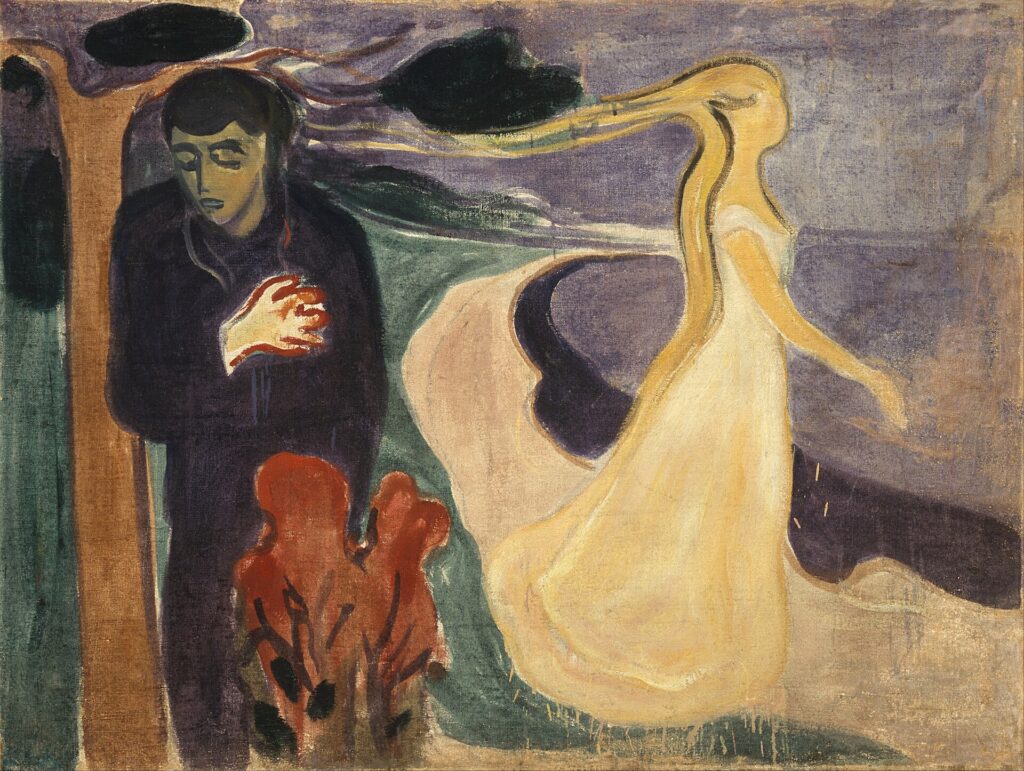
Each of us carries a picture of what love looks like. Not the one from films, but the first one, learned before we could choose: how attention is won, what you have to do to be loved, what happens when someone leaves. If love in childhood came rarely and had to be earned, an adult will find it hard to recognise love that comes easily. It feels boring or suspicious, as if it is “not the real thing”. An unavailable person, on the other hand, feels familiar, and that familiarity gets mistaken for attraction. The Serbian poet Dis has a poem in which the dead of a distant past visit him at night. Repetition in love is exactly that kind of visit: the past, which does not remember itself as the past, arriving dressed in a new face. Freud called it the compulsion to repeat, the tendency to re-enact what once hurt us, as if this time we might manage to put it right. Repetition, then, is not bad luck. It is an attempt, a poor and costly one, but an attempt all the same to make an old scene end differently at last. The trouble is that we choose precisely the partners with whom that scene cannot end differently.
Repetition is not bad luck. It is an attempt to make an old scene end differently at last.
An example
The example is invented and put together from several typical situations.
A woman in her thirties comes after her third relationship has ended the same way. The man is attentive at first, then slowly drifts away, and she tries harder and harder to bring him back. In the first conversation she says she “always attracts the wrong ones”. When we look more closely, it turns out she does not attract them; she chooses them, and very precisely. Men who are available from the start strike her as “soft” and do not interest her. Underneath lies a sentence she has never said aloud: love is only worth something if it has been won. She learned it in a house where her father was present only when she had done something well. One can reach that insight within a month, but that is not where the work ends. The task we agreed on was small, almost laughable: not to turn down a man who was clearly interested with “he’s not my type”, but to go on a second date and notice what she felt when no one was running away. First she felt bored, then afraid. Only after that did she feel something she had not known before: calm. That is the moment when the old rule runs into reality for the first time and turns out no longer to hold.
What can change
I do not believe this kind of repetition is broken by a decision. “From now on I’ll choose differently” is a sentence people say after every relationship, and it does not last until the next one. It is broken by finding the rule, naming it exactly and testing it in life, in small steps, until it becomes clear that the old premise no longer holds. And then one day you notice that you like someone who is not running away, and that this does not bother you. Not because you have learned to choose “properly”, but because you no longer choose by a rule someone else wrote for you. There remains a question worth asking yourself, without hurry: what did love once have to prove to you in order to count as love?