
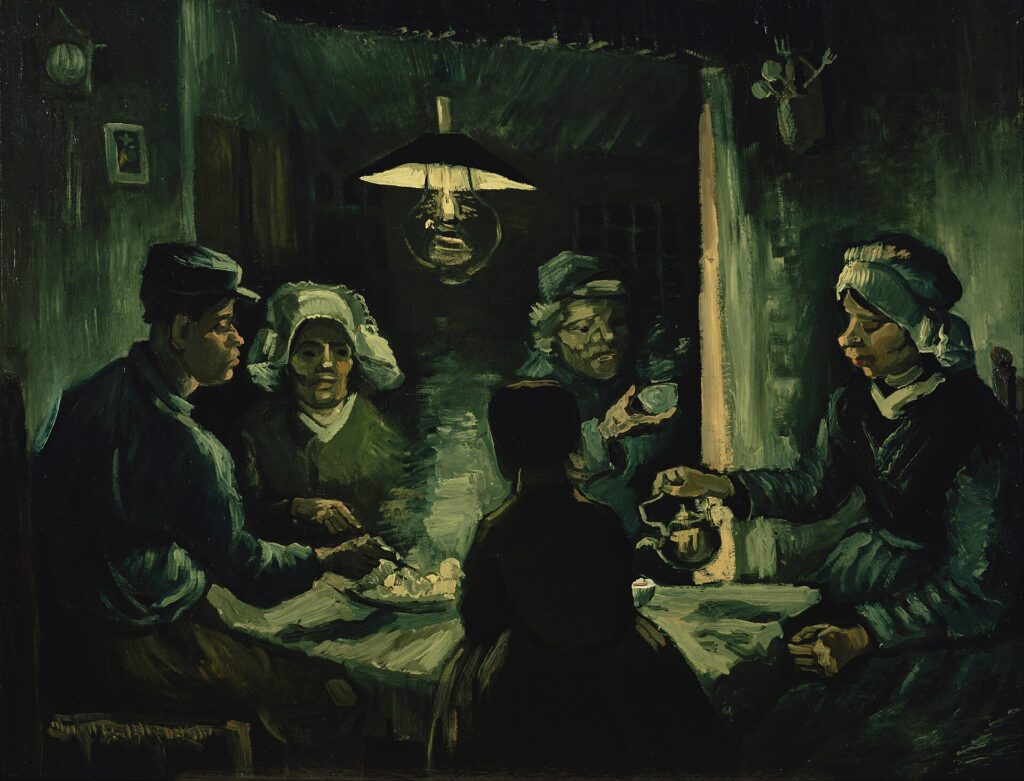
Tolstoy began Anna Karenina with the sentence that all happy families are alike, while each unhappy family is unhappy in its own way. In working with families I have seen that this is only partly true. Unhappy families do look different, but they almost always get stuck in the same place: people who grew up long ago sit down at the family table and within five minutes become who they were at fourteen. This text is for those to whom this happens, children and parents alike.
Roles that do not age
In every family each person has their place. There is the responsible one, the difficult one, the one who keeps the peace, the youngest who is forgiven everything. These places are handed out early, often before the child has learned to speak, and nobody chooses them. Outside, in the world, people change: they become parents, managers, successful, tired. But when they walk into their parents’ house, the family puts them back in their old place, and they return to it, to their own surprise, without resistance. Parents go on talking to the child who once was, and children go on answering the parents who once were. Everyone defends what they remember, and no one sees the person sitting opposite.
At the family table no one grows older: everyone sits in the place they were given long ago.
When old accounts are reopened
Families usually come at turning points. An ageing parent’s illness and the question of who will look after them. An inheritance. Grandchildren, and the question of who is allowed to tell them what. One of the children’s divorce. The death of one parent, after which it turns out that he was the one holding the whole family together, and nobody knew. At such moments it is not only a new question that opens, but all the old accounts: who always helped and who left; who was the favourite; what has gone unspoken for years. When one member tries to behave differently at these moments, the others, with no ill intent, pull them back to their old place. A family defends its order even when that order harms everyone, because it is familiar, and the familiar feels safer than the unknown.
An example
The example is invented and put together from several typical situations.
Three children in their forties and a mother of seventy, a year after the father’s death. The elder daughter, “the responsible one” since childhood, visits her mother every day, takes her to the doctor, and is exhausted to the point of collapse. The younger son lives abroad and calls on Sundays; the mother speaks of him with pride. The middle son is silent, as always. At the first meeting, with the son abroad joining online, each spoke about what the others were not doing. At the table, invisibly, sat a rule that applied to everyone and that no one had ever said aloud: in this house you do not ask for help, you give it. The daughter did not ask for help because “there was no need”. The brothers did not offer because nobody asked. The task was for the daughter to say “I can’t” one week and leave an empty space, and to see who would fill it. To everyone’s surprise, it was the one abroad: he took over booking the appointments and dealing with the doctors. And at one of the meetings the mother said something she had never said before: that what she feared most was being a burden. Only then could the rule be seen, because she was afraid of it too.
What can change
Family work does not promise reconciliation at any price. Sometimes the outcome is a closeness that has been missing for a long time, and sometimes a better, calmer distance, in which people stop expecting from their family what it cannot give. Both outcomes are good if they are chosen rather than stumbled into. I take no one’s side. My job is to make sure everyone is heard and that what has gone unspoken for years gets said at the table, and then to test in life, between meetings, what happens when someone leaves the place they were assigned. To finish, one question: who are you at the family table, and is that still you?