
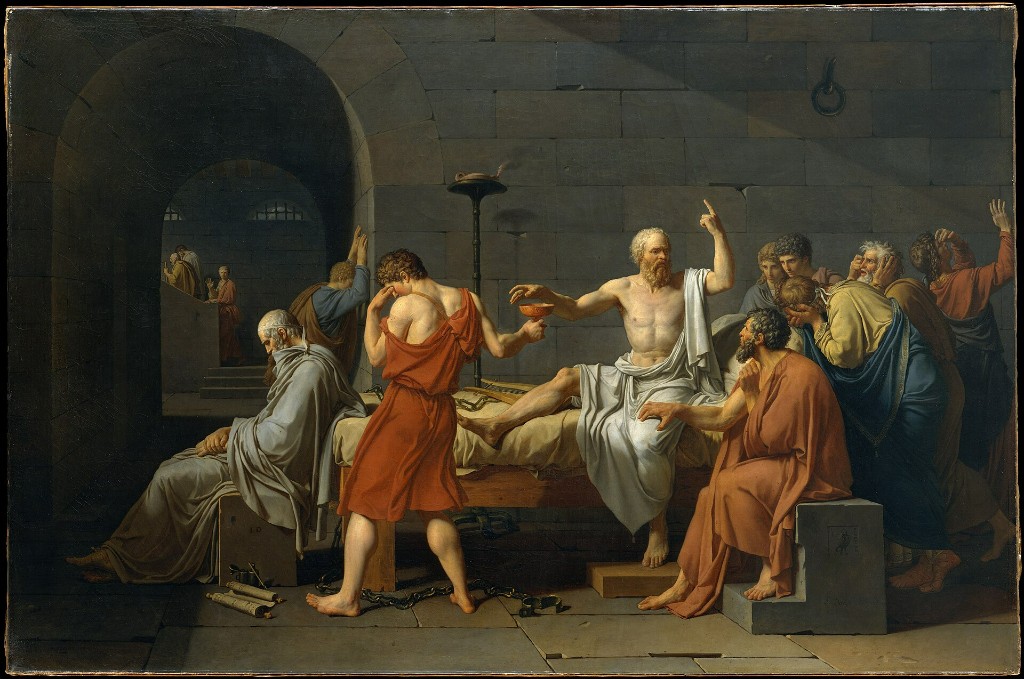
Psychotherapy is regarded as a modern discipline, a little over a hundred years old. The question it answers is much older. How do you live when it hurts? What do you do with fear, anger, grief? Before there was a single school of psychotherapy, philosophers were asking these questions and answering them through conversation.
Philosophy as medicine
For the thinkers of antiquity, philosophy was not a university subject but a way of life, and one of its tasks was to heal. Socrates spoke of the care of the soul, and died reminding his friends that they owed a cockerel to Asclepius, the god of medicine. Epicurus, according to a later account, held that empty is the word of a philosopher by which no human suffering is healed. Cicero called philosophy the medicine of the soul. The Stoics developed real exercises: how to pause before reacting, how to tell what is in our power from what is not, how to prepare for loss. Epictetus wrote a sentence that psychotherapy textbooks still quote today: people are disturbed not by things, but by their opinions about things.
Before there was a single school of psychotherapy, philosophers healed through conversation.
How the root branched out
When psychotherapy emerged at the end of the nineteenth century, it presented itself as part of medicine and science, and for a long time kept philosophy at a distance. But the root remained. Ellis and Beck, founders of the cognitive schools of psychotherapy, openly drew on the Stoics. Existential psychotherapy, from Binswanger to Frankl and Yalom, grew out of Kierkegaard and Heidegger. And psychoanalysis, although Freud claimed to avoid philosophers, constantly dealt with questions that are philosophical: what is the truth about oneself, what is freedom, what does it mean to desire. At the end of the twentieth century, philosophy for its part returned to practice. In 1981 the German philosopher Gerd Achenbach opened the first philosophical practice, a place where a person comes to talk with a philosopher about their own life. Since then, philosophical counselling has developed in many countries, as a relative of psychotherapy rather than its rival.
One root, different fruits
Psychotherapy and philosophical practice differ today in many ways: in training, in methods, in the kinds of difficulty they work with. Psychotherapy deals more with suffering that gets in the way of life, philosophical practice more with the questions life raises. Yet both stand on the same old idea: that a person can change by thinking and speaking about themselves differently, in conversation with someone who knows how to listen and how to ask. That idea is older than every school of psychotherapy and will outlive each of them. There remains the question the ancients asked before every conversation: what do you need, a remedy or an answer? And are you sure they are not the same?
If you are wondering what you need, the first conversation is free.